
Hello. I just wanted to let you know that the dimwitted author set their password to “password”. This left a glaring security hole in their website.
I’ve just read over all of this nonsense, and I’d like to tell you all that you’ve wasted your time. The author is a complete idiot. See, they’ve led you to this ridiculous blog, in an attempt to sell you something or gain clout or some other reason. The whole premise of all of this nonsense is f*cking absurd.
I’ve read this question that asks:
Question #3: Does changing the intensity of a single RGB light change its colour?
The answer the author of this horrible site gave is so completely ridiculous, so completely out to lunch, that I can’t even begin to know where to start. Look… I don’t have long here as they might flip their password over to “Gretzky” or something and lock me out. So let me try to be very quick…
The idea that “colour” in the usage of “colour matching” experiments, or “the colour of light” is nonsense. Straight up, pure, unadulterated horsesh*t. Why? Because colour doesn’t exist outside of our cognition. Colour, as much as it is familiar to all of us in an intimate way, is actually a relationship. We might think of the simplest form of this as a relationship of A to B.
Let’s look at a simple example…

The “diamonds” in the interior regions are of equal tristimulus. The percept of the diamonds, however, is one of significantly different “lightness”. Generally folks will perceive the lower diamonds as “darker”. If we change the arrangement, or, to use David Katz’s terminology from his 1935 book The World of Color, the articulation, of the picture tristimulus, we end up with a very different cognition endpoint. This also happens when we change the field size by zooming in or away from the picture!

“This is just illusory!” I can hear the idiot author shouting. Sorry, this is not illusory. To suggest these are “illusions” is to undermine the very foundations of our visual cognition. We don’t “see”, we cognize.
Another incredibly striking example is the glare and halo effect. Take note how the following showcases that despite identical tristimulus values, the “interiors” of the petals are cognized vastly differently. Simultaneously, albeit more subtly, note how the “exterior” of the petals are also subject to this spatio-temporal visual mechanic.

So why show these simple examples? Aside from being wonderfully economical in their ability to showcase how the spatio-temporal articulation of signals play the lead role in our visual cognition of all things, they pose a question unto themselves. Are these sorts of striking visual cognition mechanics somehow isolated, or infrequent in nature?
If we flip our entire world-view upside down, and dig a little deeper beyond the hallowed halls of CIE Colourimetry with respect to our discussions of colour, we rapidly realize that colourimetry, as explored in the previous 29 questions from the idiot author, is nothing more than a niche slice of a hotly contested surface.
We can go all the way back to Helmholtz and Hering who apparently engaged in sh*tposting of each other’s work to see that the tenets and concepts of visual mechanics have been at least as territorially complex as modern day geopolitics. Today, the landscape of vision studies fractures into many different fields, and these fields do not agree on much of anything. In fact, to get a generalized idea of the landscape, it would require crossing over disparate fields such as computational vision, lighting, art, design, neurology, neurophysiology, biology, and many, many other fields.
The idiot author of this blog has done a disservice to you all by suggesting that colourimetry is the bog standard, uncontested world view of all of colour, and therefore digital colour. It is nonsense.
If we are to anneal our understanding in the pursuit of making our art and design work in these sloppy computers and mediums more stable, we have to explore the formulation of colour in our visual cognition systems, and separate the visual cognition of the term colour from the “outside” world.
Looping back to the Adelson Snake demonstrations, we can ask ourselves whether or not the spatio-temporal articulation impacts our sensation of colour. And the answer is of course provided by none other than Dr. Akiyoshi Kitaoka, who did some riffing on the original Adelson demonstrations above. Dr. Kitaoka has provided us with compelling evidence that, as broadly hinted above, the spatio-temporal articulation impacts all of our visual cognizing of colour.
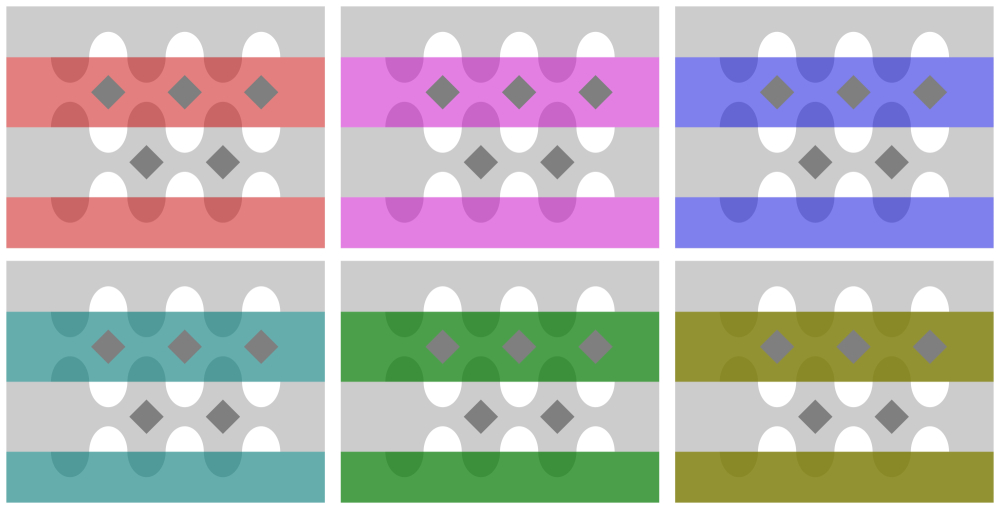
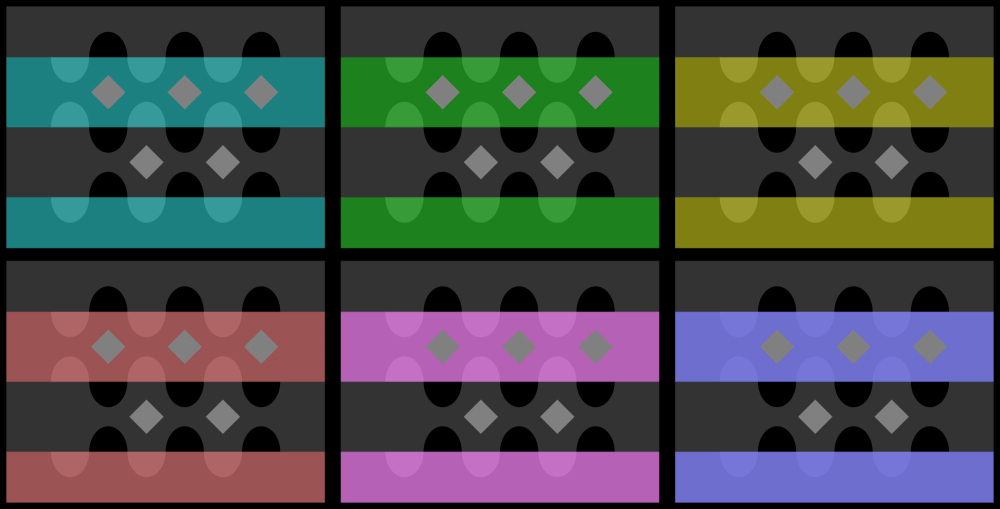
The above Dr. Kitaoka demonstrations are compelling examples as to how neglectful the basic measurement comprehension, usually in tristimulus units, of “colour” is. We can clearly see how a global frame of the stasis of R=G=B in our lower order systems can lead to percepts of colour in the visual cognition chain.
We ought to be able to revisit the idiot author’s third question and begin to paint a completely different framework for discussing “colour”.
In terms of ratios, changing the magnitude of the channels in an additive RGB system uniformly does not change the “measurement” in terms of colourimetric chromaticity. But colour? The colour as formed in the visual cognition pathways does change. Why? Because the above examples should at least hint toward the idea that colour is a broader cognitive activity, and part of the cognition relates to the spatio-temporal relationship in the articulated field.
Why do I keep hammering “spatio-temporal”? Why not just “spatial frequency”? Because the two are the same thing. Our visual cognition is tremendously reliant on the temporal relationship. Some colour might look a certain way and, given unique spatio-temporal relationships, shift! In fact, our visual field is ever changing based upon the biological feedback loop from the higher order processing.
First up… the classic Troxler’s fading demonstration. Hold your visual field firm and fixate on the cross. One should find that the spatio-temporal articulation of the “colour” dissolves.

And of course, the temporal side is made more evident with this variation of the Troxler Fading effect. Here, as we fixate on the cross, we cognize a similar spatio-temporal colour as present in the above Dr. Kitaoka demonstrations.

Perhaps the most mind numbing part of our visual cognition, and how time is intimately related to visual cognition, is nicely demonstrated through contrast asynchrony. As the relationship between values shifts, our sensation of timing shifts. There is a wonderful demonstration of contrast asynchrony given at Michael Bach’s website. Mark Wexler has posted a video demonstrating fixed rings that induce similar temporal strangeness.
It is difficult to discuss spatio-temporal articulation effects without Dr. Arthur Shapiro‘s name making an appearance. He too has some wonderful interactive demonstrations on contrast asynchrony over on his website. He is also a profound force in understanding the complexities of articulation, having written dozens of papers on the subject1.
I think the idiot author has just logged in, so I should be going. If you remember one piece of this guest post, it is to pay close attention to terms such as “colour”, “lightness”, “darkness”, and any number of the other terms floating around out there. No one understands visual cognition, and you shouldn’t feel too bad if you cross over conflicting use of terms and phrases. Even the folks with PhDs after their names do not necessarily agree on fundamental definitions!
Answer #30: Uniformly changing the ratios of tristimulus in an additive RGB system does not change the “measured” colourimetry, however the colour *does* change!
This statement might seem contradictory, but if we keep a separation between the idea that colour is psychological internal visual cognition, and that the human made measurement of tristimulus is separate from such, we can probably get a better handle on things. We could go further and hammer home the general idea that light doesn’t have a f*cking colour!
A critical building block in this post is to begin to think about colour, in the psychological visual cognition sense, as a construct predicated on articulation. Knowing how absolutely fundamental articulation is in visual cognition can help us to spot nonsense before it takes root.
Oh crap… here he comes… let’s hope he doesn’t carry on misleading you in the next question…
1 Dr. David Eagleman has written numerous papers on the perception of time, and some have explored the timing of perception of visual signals in relation to cognition. Truly mind expanding for those interested in the relationship between visual cognition and time.
 The Hitchhiker's Guide to Digital Colour
5 replies on “Question #30: What is the F*cking “Colour” of Light?”
Hello.
Before I noticed this article I was reading some terms of the ILV, and got confused. Does the articulation of the picture tristimulus impact our sensation of color? Or the perceived colors? Or both? Who are you??
Thanks in advance.
LikeLike
> Before I noticed this article I was reading some terms of the ILV, and got confused. Does the articulation of the picture tristimulus impact our sensation of color? Or the perceived colors? Or both?
Hopefully the article somewhat answers these questions. But broadly:
1. “Colour” is entirely a psychological phenomena. We do not “sense” colour, we form it in our cognition systems. To suggest that we “sense colour” is to get the entire visual cognition system backwards. As such…
2. Given that there is only visual cognition, the spatiotemporal articulation is **the** driving force behind colour sensation.
So absolutely 100% yes; spatiotemporal articulation is foundational in our visual cognition formation of colour. But caution… your question suggests that the understanding is Newtonian… that colour “exists” outside of the human mind. It does not.
> Who are you??
Just another idiot online. Don’t listen to me!
LikeLike
Hello again. You’re cool!
It has become clear to me that we don’t sense color at all. I should have mentioned that I doubted when I read the concept of “sensation of colour” in this very article!
Regards.
LikeLiked by 1 person
Great examples but do not completely agree with the conclusion. Namely, with the thesis that “Colour, as much as it is familiar to all of us in an intimate way, is actually a relationship.”
This is later explained as a “spatial-temporal relationship”.
Let’s consider “spatial” part to be true. It would mean that no color perception is possible if there is a lack of other color perception in the field of view.
But such things as perceptions of unrelated colors exist:
“The most complete reductive change from natural viewing conditions is
experienced in the so-called aperture mode, where colors are seen as unrelated.
Practically, this is approximated by viewing a uniform color field through
a narrow tube of black paper, by using a so-called reduction screen (a sheet
of black construction paper with an opening cut in the center) or, most perfectly, by viewing a color field on an otherwise black monitor in a dark room.
Such fields have the appearance of lights and the situation is similar to experiencing a colored light at night. Unrelated colors are rare experiences, mostly obtained in a laboratory. A stimulus experienced as brown as part of an object in natural surroundings is seen as orange or yellow in aperture mode. Similarly, live green, navy blue, or gray do not exist as unrelated colors.”
Rolf. G. Kuehni. Color: an introduction to practice and principles (2012, p. 55).
It could be argued that black paper / black surroundings itself creates a color perception by introducing a relation between “black” and presented color. In case of the black paper I could agree with that.
On the other hand, in case of black surroundings, if the field of view is filled with the color, we do not have an immediate spatial relation between two colors. We could say that there is a possibility of the relation or subconscious cognition of the possible relation, because we can turn our head.
But this gives the thesis more broad, philosophical meaning.
We could argue that every perception is related to other perception. But this does not imply that the nature of every perception stems from that relationship.
LikeLike
Thanks for visiting!
“Blackness” is a relational decrement signal in the Off-On / On-Off cells. The ganglion arrangements pull fields of the cells together and pool their responses.
As such, there’s no such creature as an “unrelated” stimulus. That’s nonsense.
Gilchrist’s work here is relevant.
> On the other hand, in case of black surroundings, if the field of view is filled with the color, we do not have an immediate spatial relation between two colors.
Colour isn’t stimulus. It’s a cognitive machination that emerges from layers of cognition, with the *differential* signals providing an ingredient. Even the notion of “blackness” is a *signal*, and falls into precisely into the same mechanics of spatiotemporal articulation. For more information about the nature of Off-On and On-Off signals, it is worth researching the studies originating with Hartman 1938, progressing through Kuffler 1953, and ultimately culminating in Hubel and Wiesel’s 1959 work. From there, Gilchrist’s1 work will reveal much about the spatiotemporal articulation of the fields, and the emergent cognition and reification of “blackness”.
> On the other hand, in case of black surroundings, if the field of view is filled with the color, we do not have an immediate spatial relation between two colors.
A “full” field is effectively a complete null, and any differential that were introduced temporally, would result in a “null” signal over time, eventually diminishing the signal and cognition that emerges. In addition to a complete feed of null signals, there remains the temporal aspect of the spatiotemporal field, and the cognition of colour will attenuate. This is why we do not cognize the layers of veins resting atop of our cellular sensory apparatus! See Yarbus; without a differential along the spatiotemporal axis, visual cognition is not possible.
—
1 Gilchrist, Alan, Stanley Delman, and Alan Jacobsen. “The Classification and Integration of Edges as Critical to the Perception of Reflectance and Illumination.” Perception & Psychophysics 33, no. 5 (September 1983): 425–36. https://doi.org/10.3758/BF03202893.
LikeLike