Ever wonder just what is happening when you are pushing pixels around? This is a series of articles to help you, the image maker, survive in a world full of bulls*it regarding digital colour. If you are confused about digital colour, it’s not your fault.
With the previous Question #34, we began a discussion of “Seeing X in Y”. Given that we have at least a fundamental grasp of the idea that a pictorial depiction is not an “innate” experience, but rather a cognitively mediated construct, what can be said about the construct of “colour” specifically?
Let’s try to bundle up the question in this post…
Question #35: Under the lens of the historical mythology of a picture’s capability to “reproduce reality”, what should we take away as important regarding the stimuli in a picture that we cognize as “colour”?
We have to remember that colour photography has emerged as an historically shaped phenomena. The material mechanisms had to be invented, and further along the historical path, the ideas were subject to design and engineering choices, subsequent research and development, and even human marketing and hubris.
So too was the commercialization of the photograph, by way of the entities that produced the material employed to craft, process, and reproduce the photographs. It would be an understatement to suggest that Kodak played an outsized role. Of course Agfa, Fuji and other vendors produced motion picture and still photography creative film, but likely due to American exceptionalism, language barriers, and other sociopolitical reasons, the bulk of Kodak’s employees produced written work that became the “canon” in photographic scientism circles. In fact, a disproportionate number of the names in the research papers linked on this hellish website, in terms of the scientism around colourimetry, were employed by Kodak to produce those papers.
Why are we pointing at Kodak in this archeology of the photographic “realism” discourse? Let’s look to 1950…
Historical Brain Worms
The advent of “practical” colour motion picture film roughly landed en force in the 1930s. Kodak’s Kodachrome, a significant step in the mainstream adoption of colour motion picture film, took flight in 1935. While other vendors were coming to the fore in motion picture work such as Agfacolor Neu / Agfacolor landing in 1936, we are going to focus on Kodak here, due to the historical archaeology we can follow by way of the academic trail1.
The reason that Kodak, even today, remains an outsized force in these discussions around colour, is that as outlined prior, many of the minds propelling creative chemical film forward were writing theory and papers on the subject matter found within this wretched website2. As such, the minds that theorized and researched black and white creative film photography, bridged over to colour film. And from colour film? That’s right… the very same minds, often at the forefront of committees and standards bodies, were responsible for laying the groundwork of the evolving landscape at the time. Those standards ended up being the path that other folks would turn to regarding stimuli specifications, and found their way into the discussions around colour television.
It should not take a rocket surgeon to realize that it is a relatively short mental hop from colour television, to monochrome computer displays, to colour computer displays, to the deluge of orthodox theory around pictures in our contemporary era.
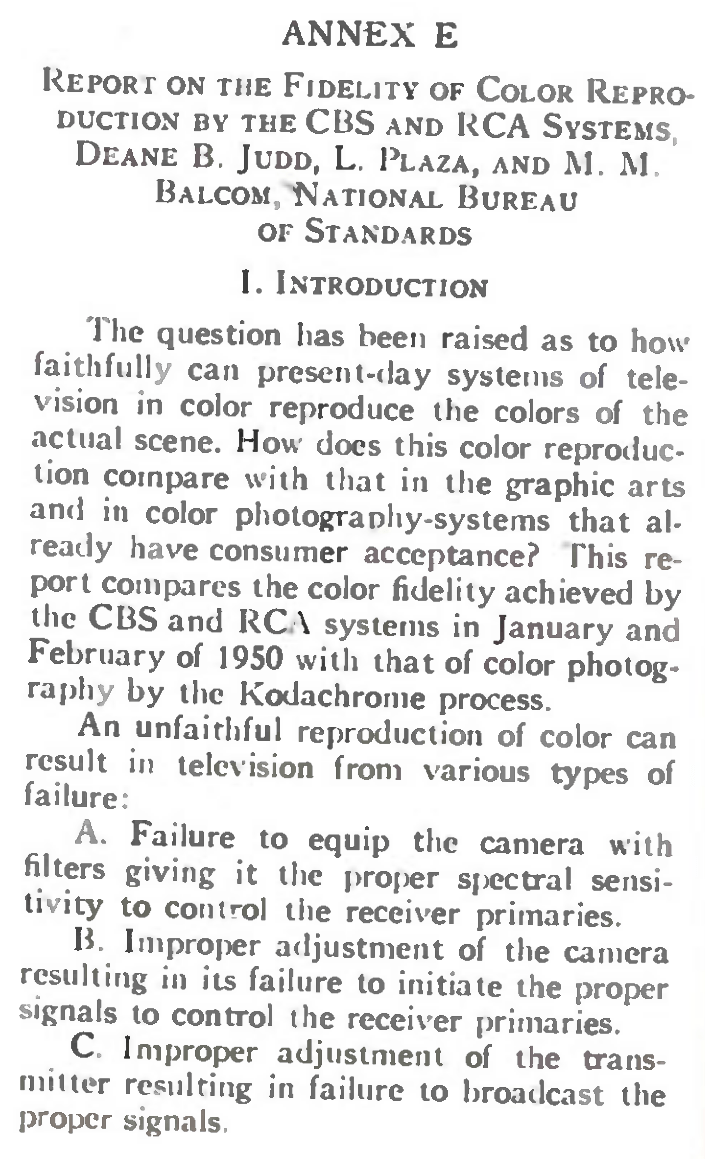
Given a small and insignificant historical footnote known as World War II that occurred during our particular era of study, most of the consumer facing emerging field of electronics hit a bit of a standstill, for… reasons. If we look to 1950, an important, albeit little known report appears on the landscape titled The Present Status of Color Television; a report by the Senate Advisory Committee on Color Television3. Within the report, Annex E, authored by Deane B. Judd, Lorenzo Plaza, and Margaret M. Balcom, appears toward the end. Deane B. Judd should be a familiar name, especially for folks who are vaguely familiar with the work around colourimetry and Kodak. As for potential reading entertainment, labelling the report a rather dull affair would be an understatement. There is, however, a notable passage within this lost Annex E…
The first “contemporary” appearance of the offending a priori myth that your author can cite with historical confidence, with specific attention to the domain of electronic picture depictions.
We have to remember that in terms of our contemporary ideas around pictures and colour, this passage arguably represents a significant historical artifact. It is, as best as your author has determined, one of the earliest statements as to a conjecture of an “implicit goal” of electronic pictorial depictions. Further, it’s one of the earlier appearances of the bogus term “scene” in relation to Kodak’s canon as it congeals and takes form in the contemporary era.
This is, after all, 1950, and colour television is yet to become a commonplace thing. In fact, the general public was introduced to colour television on January 12th, 1950, when CBS showed its field sequential demonstration5.
Arguably the industrialization of colour motion picture film photography work took significant flight with the successes of The Wizard of Oz, August 10th, 1939, and the previous Snow White and the Seven Dwarfs animation December 21st, 1937. This is not to discredit the colour motion pictures prior, but to draw attention to a more “mainstream” lensing. For those who were around when James Cameron’s Avatar was released6, hopefully we can see how a seemingly “singular” piece of work can appear to compel an entire cultural zeitgeist, and industry, into adoption. As we can see with Avatar and 3D, the ideas were… uh… let’s just say the “inevitability” of the 3D idea became questionable at some point.
Between the mainstream advent of colour film presentations, and the above Judd contributed Condon report Annex E on the subject of colour television, we have a mere decade, plus or minus. That’s not a long time! Now onto the offending passage. Did you spot it? Let’s pull it out:
The question has been raised as to how faithfully can present-day systems of television in color reproduce the colors of the actual scene.
— Judd, Plaza, and Balcom, 1950, spelling color without the Queen’s U.
At the very least, it should be striking how effortlessly the authors forward an implicitly assumed goal based on an a priori assumption of fact, without any supporting evidence. It remains your author’s belief that the leap of faith in the assumption present in the first line of Annex E, is indicative of the powerfully seductive, and false, ideas around the construction of a pictorial depiction.
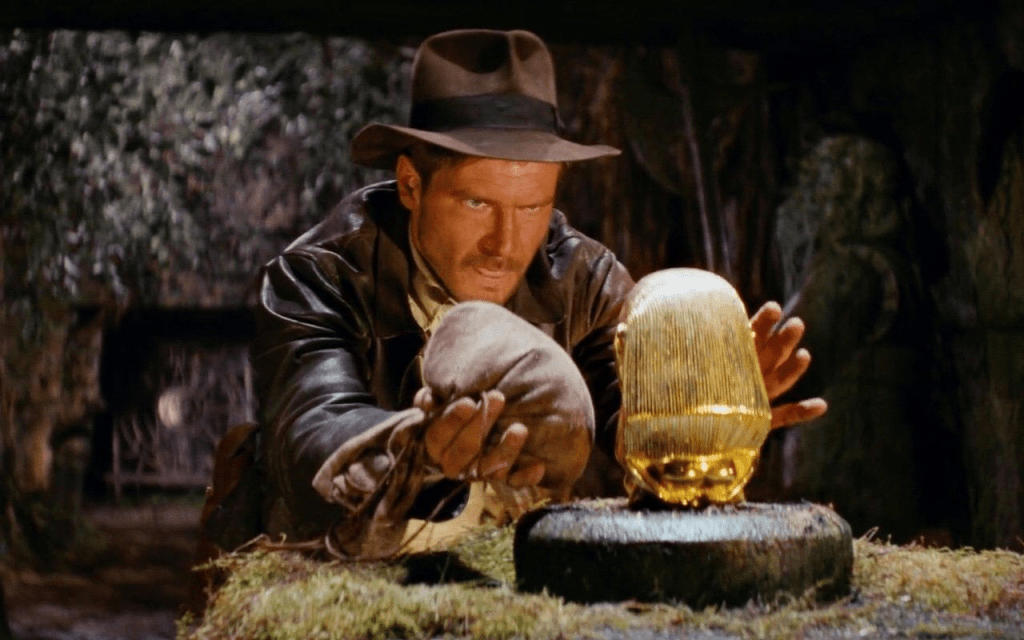
A depiction of a famous historical archaeologist, about to swap the idea that a picture is a facsimile of the stimuli in front of the camera…
Archaeological Resistance to the Colourful Brain Worms
This peculiar, otherwise insignificant passage would likely have gone unnoticed if it were not for another Kodak alumnus, David L. Macadam, whose name has appeared elsewhere in the slithering mass of glyphs you are now reading a passage from. Of the many papers that MacAdam authored, one in particular is worthy of note in this focused archaeological expedition. That paper? Quality of Color Reproduction7. Even the title, with the term Reproduction, smacks of our Question #34 myth, doesn’t it? In fact, let’s pull the idea out, before we press ourselves into this booby trapped temple any further.
Is the role of a pictorial depiction to reproduce the colour of what was in front of a camera? And if we historicize our terms, we should have a pretty good idea that when a Kodak-ite utters the term colour, they mean stimuli. Substituting terms, we arrive at the question…
Should a pictorial depiction seek to reproduce the stimuli present in front of the camera?
Your wretched author asking a wretched question.
Yet again we are faced with glaringly stupid questions that only minds lost on a bad ayahuasca trip would even think to ask. It is hoped that more minds become aware of this longstanding trope that pervades our thinking around pictures. Let’s dive in…
MacAdam (Sh*tposting) to Judd
Judd seemed to have been a bit of a porcupine89, one that your author will hopefully find the energy to trace an outline of in a future posting, as Judd’s role in a broader narrative around “How we got to today” in terms of pictures, is significant.
Despite the title of MacAdam’s 1951 piece using the term “reproduction”, it seems that the paper is largely engaged with tackling the assumption of whether or not “reproduction” of stimuli is a reasonable goal at all. MacAdam hints at the peculiar nature of photography in his opening:
When asked how he obtained such delicate flesh tones in the nudes for which he is famous, Renoir is said to have replied, “I just keep painting and painting until I feel like pinching-then I know it’s right.” Color photography and color television are far from such perfection, but no better prescription for improvement can be written.
Judgment and measurement are indissoluble partners in the task of assessing quality of color rendering. Color can be measured, as can weight and height, but no formula can be trusted to distinguish pleasing from displeasing color, any more than a formula based on dimensions guarantees beauty of form. The principal value of measurements in such problems is that they permit something to be recorded about the occasion when satisfaction is experienced, or dissatisfaction expressed. The judgment, “I like that,” is fundamental to all knowledge of what constitutes a good picture, but the knowledge is as evanescent as the picture if no measurements are made to record what the picture was, when it was approved. However, it is useless to make measurements blindly. The most revealing measurable characteristics of a picture, as of a beautiful form, can be discovered only by searching for whatever specifications are shared by all pleasing examples and more or less violated by less satisfactory ones.
Of course it is with hope that our dear readers will spot the error of conflation of stimuli with colour cognition again in MacAdam’s leading passage, but it is an insightful passage nonetheless given the discussion of quality of colour. MacAdam continues:
Neither painters nor those in charge of color control in photography or television can hope to succeed by blind reliance on measurements. If a modern painter should venture to assert that he surpasses Renoir in the ability to render flesh tints, on the grounds that measurements prove his tints are closer to those of the living model, he would quite properly be dismissed with ridicule. Renoir’s paintings do not, and probably never did, “match” the flesh of his models. This is not a criticism of Renoir, but an object lesson from which we should learn to investigate carefully before we rely upon “color fidelity” measurements.
What is intriguing is that MacAdam is softening the blow of the suggestion that any sort of metric analysis is futile here. We have to remember that MacAdam’s experience and understanding of photography at the date of publishing this paper is significant. MacAdam continues:
No formula for the evaluation of the quality of reproduction is recommended. It is doubtful that any valid formula can be derived from the fragmentary and largely contradictory data now available concerning visual sensitivities and tolerances for color errors.
This blast of artillery in the opening passage is striking given someone who has dedicated their academic career to enumerating metrics around the photographic medium, and the more nebulous ideas around colour.
So having set the stage, let’s drill deeper into how Judd’s passage fits into the broader pattern MacAdam is analysing.
“speaking truth, truth-telling,” 1650s, from Latin veridicus “truth-telling, truthful,” from verum “truth,” neuter of verus “true” (from PIE root *were-o- “true, trustworthy”) + dic-, stem of dicere “to speak” (from PIE root *deik- “to show,” also “pronounce solemnly”).
As hinted to prior, when we speak of a “goal” of a picture, there is a consistent and recurring thematic that all we would need to do is replicate the stimuli in front of the camera as closely as possible, and the rest will “Just Happen”.
Of course, readers of this horrible website will at least likely have developed a bit of healthy skepticism about this stance. Specifically, there is an ideological framing behind most of these sorts of theist beliefs; that the stimuli in the physicalist-materialism sense is the veridical. The physicalist world, and our measurements thereof, is the true.
MacAdam seemed to be drilling into what could be read as at least an interrogation of this basic assumption. Why shouldn’t the materialist / physicalist stimuli in front of the camera be the veridical ground-truth? Is this not an obvious conclusion? MacAdam, referencing the Condon Report, begins his suspiciously scathing assault:
However, in themselves, color specifications lack any critical value. “Color fidelity,” defined as “the degree to which the television receiver reproduces the colors of the original scene,” reveals a serious misconception of the purpose of both color television and color photography. This definition prejudges the facts, quite mistakenly, according to present indications.
Over the next pages, MacAdam begins a dissection of the metrics of “colour”, and discusses “matching”. Again, MacAdam employs the stimuli metrics in an overreaching manner, and implies the recurring belief that a stimuli “match” can be considered synonymous with “colour”. However, this fault line set aside momentarily, the paper marks a rather noticeable departure from papers of the era that are all too frequently riddled with numbers, formulas, and mental gesticulations offering conjectures of said metrics.
Onward To Weird
MacAdam’s paper is significant as it is one of the earliest papers encountered by your author that tackles the inconvenient truths of an “idealized” pictorial depiction trying to “match” the assumed veridical ground truth of stimuli. In fact, there are several amazing passages of this “weirdness”, including a specific humorous term, that are contained in the paper.
MacAdam’s inquiry describes the degree of differences along colourimetric analysis lines:
It is interesting to note that photographic limitations are not entirely responsible for the discrepancy between objective reproduction and preferred reproduction.” According to Jones, “there are many cases where we know that the perfect objective reproduction, although obtainable, is not the one the majority of judges will choose as of best photographic quality.” This effect is real and significant in magnitude.
Emphasis is your author’s. MacAdam, with this passage, has lobbed the first clear indicator that the “veridical” stimuli in front of the camera as the “goal” may not be correct. MacAdam continues:
It may be due to subjective as well as objective differences between the situations within which pictures and real scenes are observed. Only a few types of conceivable differences need be mentioned: surroundings, restrictions of field of view, modes of perception (of flat pictures rather than real objects), attitudes, emotions, and desires. Jones has shown that the differences of visual sensitivity to luminous contrast, caused by quite different conditions of adaptation when viewing the print than when viewing the original scene, must also be taken into consideration. Even if we could account for the effect, we could not neglect it, nor assume that objective reproduction is preferable to any other.
Here again, your author has emphasized a sentence to draw attention the importance of a claim that today is extremely poorly known. Even though at this point MacAdam is addressing black and white photography by way of Jones, they have identified in the prior passage that the deviation from the “original scene” is significant in magnitude, and not some mere attempt to suggest “adaptation” as a viable reason. There’s something mysterious going on. But the most powerful passage deserves its own pull quote:
It may be due to subjective as well as objective differences between the situations within which pictures and real scenes are observed.
David MacAdam, Quality of Color Reproduction
With one rather innocuous sentence, MacAdam was as prescient as Nostradamus. While he arguably jumped the shark a bit with the “real scene” statement, he is revealing a depth of insight, and perhaps more importantly curiosity, with this single statement.
MacAdam, er… Fonzie, jumping the shark.
MacAdam and (Caucasian) Skin
As one can imagine, a huge chunk of Kodak’s energy was dedicated to the pictorial depiction of (implicitly Caucasian) flesh. MacAdam gives us one of the greatest typographic descriptions of colour cognition in the annals of research papers. I give you… MacAdam’s Beefy:
Two conclusions are indicated by the diagram in Fig. 11. First, optimum reproduction of skin color is not “exact” reproduction. The print represented by the point closest to the square (“exact reproduction”) is rejected almost unanimously as “beefy.” On the other hand, when the print of highest acceptance is masked and compared with the original subject, it seems quite pale.
Further along the (implicitly Caucasian) skin discussion…
However, Judd, Plaza, and Balcom considered hue errors about four times as objectionable as equally noticeable chroma errors. In their evaluation of the seriousness of chromaticity errors, therefore, they penalized various reproductions as much for unit errors of Munsell hue at chroma 10 as for two-unit chroma errors. They did not consider that errors in some hues, such as bluish-green and purples, are much less objectionable than equally noticeable errors of hues of human skin and other familiar materials.
The emphasis is again from your author. The reason that this passage has some resonance is that Kodak had researchers such as Bartleson exploring the ideas around “memory colours”. Bartleson wrote a series of research papers10111213 on the subject, which arguably show Kodak’s willingness to explore more deeply enmeshed ideas around colour cognition.
All of this continues to beat the already long since dead horse that shows a clear and, to quote MacAdam, significant in magnitude “departure” from the stimuli “as measured” in front of the camera.
MacAdam bundles up his thoughts in a passage of literary dynamite that is worth reading in its entirety.
The discrepancy between “exact” reproduction and preferred reproduction is partly due to distortions inherent in the process, such that a certain discrepancy of a particular color is necessary to permit the best overall reproduction of all colors in the picture. But, as discussed in the case of monochrome reproduction, it must also be due to differences of the conditions of observation, or of the observer and his attitudes when observing pictures and when observing real objects. Certainly, no such discrepancies should be introduced by a picture window in your living room, nor by a mirror in your dressing room. In such a case, we usually consider that we are looking at the “real thing.” Perhaps the farther we get from that attitude, the greater the discrepancy becomes. Perhaps wishful thinking is partly responsible, with or without the acquiescence of fading memory. Certainly, differences of adaptation must play some part, but, for the ordinary range of adapting conditions when viewing scenes and pictures, this cannot account for more than a small fraction of the discrepancy shown in Fig. 11. Whatever the causes, the discrepancy is real, and is typical of the conditions under which photographic portraits are viewed. Since similar distortions and conditions of observation are customary with motion pictures and television, similar discrepancies are likely to be necessary for best results with those media. Face colors in 25 portraits of exhibition quality have been measured. Ten of these were made with the Kodak Flexichrome Process, in which every color is completely and separately under the control of the artist, so that no compromises are necessitated by chromatic distortions of the process. Three others were pastel portraits of children by two professional artists, and two were oil paintings by a prominent contemporary artist. The original subjects were not available for spectrophotometric measurement, but the foreheads of twelve more young people were measured, in order to establish the approximate range of face colors. The range of face colors in the portraits was entirely separate from the range of natural face colors, and the separation of the centers of those ranges is approximately the same as indicated in Fig. 11. Therefore, it seems to be not only quixotic but fallacious to assume exact reproduction to be the norm, or to measure degradations from that basis.
MacAdam’s Beefy.
So where does this archaeological expedition of one of MacAdam’s papers leave us? If, dear reader, we are to walk away with a key bullet point, the following would be very useful as we move forward to drill into some fascinating bits around pictorial depictions. We’ll borrow some of MacAdam’s statement in our answer…
Answer #35: An “idealized” pictorial depiction of what was in front of the camera should be considered fallacious to assume exact reproduction to be the norm, or to measure degradations from that basis.
We are once again faced with what is emerging as an inconvenient truth; that an “idealized” pictorial depiction cannot be a one-to-one simulacrum recreation of the stimuli that was in front of the camera. As MacAdam’s Beefy, among other investigations such as Bartleson’s, reveals that there appears to be something extremely peculiar going on with our cognition of pictures. The “deviations” of the stimuli within an “acceptable” pictorial depiction in relation to the stimuli that was “as measured” in front of the camera, are “real and significant in magnitude.“
In the coming posts we are going to dive into how a specific branch of visual cognitive neuroscience work might offer us a chance to have a deeper understanding of what could be happening to make pictures seem to be ineffable and curious specimens. In fact, to pique your interest, let’s pull out another of MacAdam’s quotes from the above passage.
Certainly, no such discrepancies should be introduced by a picture window in your living room, nor by a mirror in your dressing room. In such a case, we usually consider that we are looking at the “real thing.”
It seems hard for us to tackle the reading of pictorial depictions without realizing that in a way, we are discussing the much broader subject of visual cognition itself. After all, just what the f*ck is a “real thing”? Heck, how does our visual cognition know that a “thing” is not part of another “thing” at all, when all we have is an array of radiant energy landing on our organism-oriented cell structures? And why, do we as late primates, “partition” thing-ness with other thing-ness? Let’s scratch the most shallow of surfaces of this discourse in the next post, but for now, it will have to just wait…
If you are interested in the history of colour photography, there is no better resource online than the brainchild of Barbara Flueckiger, the founder and project leader of Timeline of Historical Film Colors. Seriously, if you haven’t visited the Filmcolors.org website, you are missing out on a tremendous vault of knowledge. ↩︎
R. H. Sinden, Loyd A. Jones, David L. MacAdam, Deane B. Judd, Ralph M. Evans, Leo M. Hurvich, Dorothea Jameson, Bonnie K. Swenholt, to name but a fraction of the Kodak research labour. ↩︎
Judd DB, Plaza L, Balcom MM. The Present Status of Color Television; a report by the Senate Advisory Committee on Color Television. Smith N, Condon EU, Bailey SL, Everitt WL, Fink DG, eds. The Proceedings of the IRE. 1950;38(9):980-1002. ↩︎
Your author suffered a good deal tracing a copy of this wretched report. ↩︎
Apologies Jim. I love you as a good Canadian kid, but that whole Cameron-Pace 3D sled was a nightmare, and the lasting significance of Avatar on the digital content protection landscape of theatres was likely not a terrific byproduct of the success of your movie. ↩︎
It may seem like blasphemy to label Judd as territorial little beast, but alas, it is your author’s belief. Judd, being an academic, seemed rather swallowed up by their own beliefs to such an extent to write a rather scathing paper that can be interpreted as an attack on Edwin Land. There is a terrific story there, but for now the following citation will have to suffice. There are most certainly good reasons to be critical of Land’s work, but to erroneously conclude that “all of this stuff is already well known” is a disservice to what Land was exploring. ↩︎
Judd DB. Appraisal of Land’s Work on Two-Primary Color Projections. J Opt Soc Am. 1960;50(3):254. doi:10.1364/JOSA.50.000254↩︎
Bartleson CJ. Some Observations on the Reproduction of Flesh Colors. Photographic Science and Engineering. 1959;3(3):114-117. ↩︎
Bartleson CJ. Color in Memory in Relation to Photographic Reproduction. Photographic Science and Engineering. 1961;5(6):327-331. ↩︎
Bartleson CJ, Bray CP. On the Preferred Reproduction of Flesh, Blue-Sky, and Green-Grass Colors. Photographic Science and Engineering. 1962;6(1):19-25. ↩︎